
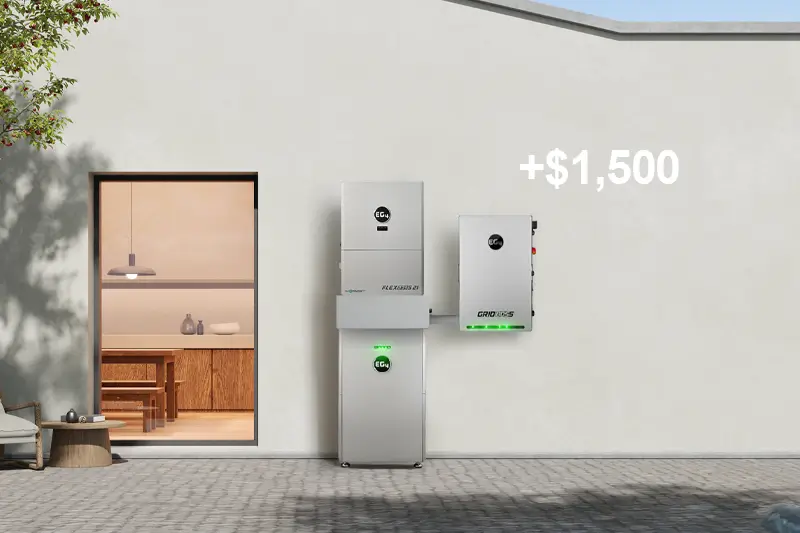
For most residential customers, energy storage has traditionally been viewed from the lens of a back-up power resource, offering similar functionality to a home back-up generator. While this certainly is an important benefit of a residential energy storage system, it does not tell the entire story of the value proposition of these systems.
Residential energy storage systems provide energy resilience in multiple forms –more well known is resilience in the face of a utility outage by creating a self-contained grid within the home but equally importantly is the resilience provided against increasing energy costs and changing utility rate structures. Over the past five years, the average residential energy price has increased over 30%, outpacing general inflation. In 2025 alone, the average residential energy cost increased over 7%, with select states above 10%1. With the continued expansion of AI and the data centers required to support it, these rates are expected to continue to rise.

Cost of Electricity Compared to Broader Inflation 2020-2025
In conjunction with rising rates of electricity, utilities and electricity providers are increasingly turning to time based residential electric rates – rates that are designed to charge more for electricity when it’s most likely to be used, like when individuals return home from work in the early evening or during the peak heat hours in warm climates. These structures are designed to discourage electricity use during hours when the electric grid is the most strained. Since 2019, enrollment in time-based rates has increased over 80%2, with many of these enrollments being mandatory.
Savy owners can take advantage of these changing rates structures by optimizing their energy storage system to charge from the utility while energy costs are low and utilize this stored energy in the home while costs are high, known as energy arbitrage, saving hundreds or thousands of dollars a year. These rates traditionally have been fairlly isolated to coastal states but recently becoming prevalent across the country. – in fact, some of the most lucrative time-based rates can be found in states that have traditionally had lower cost electricity, with some of these utilities explicitly calling out batteries as a valuable resource to use in conjunction with these plans.
Georgia Power’s Sign up for one of their Time-Based Rates
In order to assess the financial benefit of performing energy arbitrage with these rates, the lowest cost (“Off-Peak” or “Super Off-Peak”) within each time-based rate should be compared to the more common base rate customers would otherwise find themselves on. With a move to a time-based rate, the true value is not in offsetting Peak price electricity in the time-based rate but rather in offsetting the base electric rate customers would otherwise pay (a notable exception here is utilities who only offer time based rates under all circumstances). Below is an analysis of the difference in off-peak pricing versus base rate pricing for selected utilities in traditionally lower cost markets.
| Electricity Provider | State | Base Rate | Time Based Rate | Off-Peak Rate | Delta |
| Georgia Power | Georgia | 9.33¢** | Overnight Advantage | 2.19¢ | 7.2¢ |
| Florida Power & Light | Florida | 7.87¢ | Residential Time of Use | 1.71¢ | 6.1¢ |
| Entergy Texas | Texas | 8.98¢ | Residential Time of Day | 3.56¢ | 5.4¢ |
| Texas Retail Provider | Texas | 12¢ | Free Nights & Solar Days 12 | 0¢ | 12¢ |
| Ameren | Missouri | ~8.89¢* | Residential Overnight Saver | 6.31¢* | 2.58¢ |
| DTE | Michigan | ~22¢** | Overnight Savers | 15.6¢* | 6.4¢ |
| *Winter Off-Peak; Different Value for Summer | |||||
| **Blended Rate due to seasonal variance or usage difference | |||||
To illustrate potential savings of moving from a base rate to a time-based rate, we ran a simulation on each of the above electricity providers servicing a 2,000 ft2 home with average electricity consumption accounting for regional differences. Each home electricity cost was modeled using the base electricity rate with no ESS installed and then modeled again with a time of day rate and an EG4 FlexBOSS21 and two EG4 WallMount 314Ah batteries programmed to charge while rates are cheapest and discharge during high-cost periods. A deeper dive into the methodology used can be found at this end of this article.
| Electricity Provider | State | Base Rate Electric Cost | Time Based Rate + ESS Electric Cost | Annual Savings |
| Georgia Power | Georgia | $ 1,215.28 | $420.03 | $795.25 |
| Florida Power & Light | Florida | $ 1,271.66 | $260.48 | $1,011.18 |
| Entergy Texas | Texas | $ 1,168.85 | $492.27 | $676.58 |
| Texas Retail Provider (Free Nights) | Texas | $ 1,578.24 | $39.56 | $1,538.68 |
| Ameren | Missouri | $ 1,586.56 | $1,170.59 | $415.97 |
| DTE | Michigan | $ 2,839.41 | $1,826.38 | $1,013.02 |
Customers in these locations choosing to invest in an energy storage system would, on average, save ~60% annually on their electricity costs, delivering hundreds of dollars in savings per year. The magnitude of the savings depended on the length of time the peak rate was active on a daily basis – for example in Ameren the peak hours are 6 A.M. to 10 P.M. daily, meaning the battery alone would not always carry the energy required for the full duration of the peak rate – and the delta between the base rate and the off-peak rate, as shown by the increased savings on the TX Free Nights plan and within Georgia Power.
At the time of this writing, all EG4 hardware for the system modeled here would retail for between $11,670 and $13,670, depending on feature selected. Over a ten-year period, more than half of the hardware costs can be accounted for by performing energy arbitrage with extreme examples paying for the full hardware cost. This does not account for additional costs to install the system, including system design, labor, conduit and wiring, which are site dependent, however it also does not include the benefits of home back-up that would be delivered by the EG4 system, nor any revenue generated from participating in one of the many EG4 Grid Services programs that can yield hundreds to thousands in additional earnings per year.
Pairing this type of energy arbitrage strategy with solar would only serve to further bolster savings – solar production typically happens during the middle of the day when peak rates are active and the effective ‘cost’ for any battery charging using solar is $0/kWh – while also providing additional resilience during long duration outages as the solar will continue to charge the battery regardless of grid availability. However, as this analysis has shown, Energy Storage can act as a financially viable solution on it’s own, regardless of solar being added to the project.
There are numerous tools available to understand the specific savings that you might capture with a switch to time of day pricing plus an energy storage system. Across the country, utilities are providing easy to access to insights around home electricity use, including when electricity is used during the day, via Green Button Data. This data can be used to understand the energy usage during peak windows to help size a battery for energy arbitrage, while numerous Time of Use Savings Calculators exist to calculate an approximate savings from an arbitrage strategy where most or all energy is bought from the utility during off-peak hours. While this is not as robust an analysis as a true simulation of specific battery use, it does provide an effective means to estimate potential savings. For example, the number derived from the calculator here was within 7% of the modeled number for a customer in Florida Power & Light (FPL).
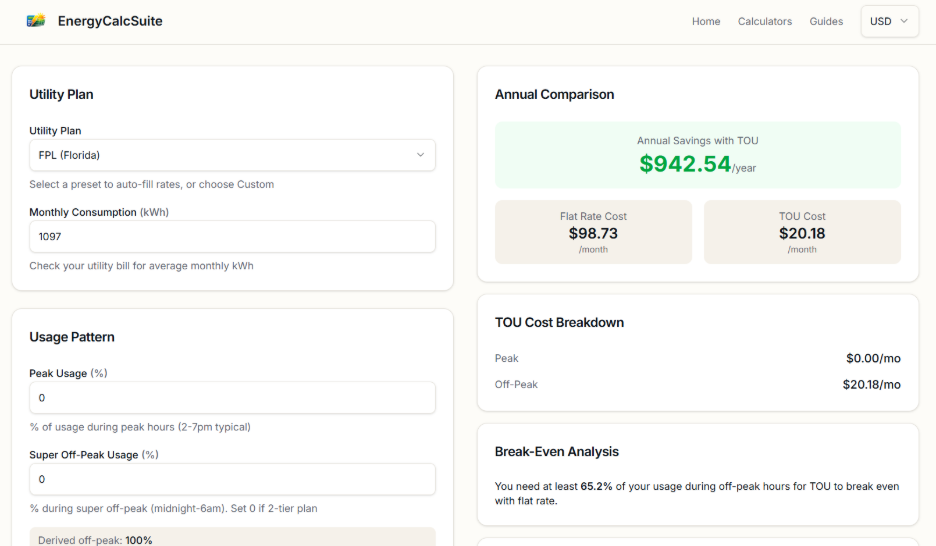
Simulation of FPL Energy Arbitrage Using Online Calculator
As this analysis shows, time of day rates and energy storage system optimization represent a compelling opportunity to generate significant savings for residential customers. Many utilities around the country are implementing rate plans built around time of day based pricing, either standard or as an opt-in. Pairing these rate structures with optimized battery performance can yield thousands of dollars in annuals savings and fully cover the cost of the energy storage system in some cases, even without solar attached. Customers with small roof surfaces or no suitable roof surfaces for solar power can now find a path toward energy ownership. TOU markets, in short, create new opportunity even as net-metering and other solar incentives are scaled back. Reach out to a local EG4 installer to learn more about how you can leverage an EG4 Energy Storage System to perform energy arbitrage.
Modeling Methodology
In order to simulate the potential savings and impact of using an energy storage system to offset peak rates in an energy arbitrage scheme, simulated 15-minute usage data was generated using an AI model for a 2,000 ft2 home in the respective regions where the assessed utilities service – the South and the Midwest. The home modeled in the South was used for utilizes in GA, FL and TX.
The model used readily available data from EIA data on the average monthly residential consumption for homes in these regions, with the load shape following the NREL/DOE End-Use Load Profile.
The following modeling assumption were built into the data:
– Lower overnight usage during sleep hours.
– Weekday morning bump from getting ready for work/school.
– Weekday daytime reduction during away-workday hours.
– Early evening increase after returning home: cooking, lighting, appliances, plug loads, HVAC recovery.
– Weekend daytime usage is higher than weekday daytime usage.
– HVAC/heating load is temperature-sensitive
– Small stochastic appliance events are included for realistic interval variability.
The Midwest home was modeled to use an electric heat pump for heating requirements, leading to a higher total consumption and more electric consumption during Winter months.
Total consumption for each ‘home’ was as follows
Southern Home: 13,152 kWh/yr
Midwest Home: 14,950 kWh/yr
The generated 15-minute interval data was used to calculate electricity costs under a base or flat rate plan in the utility being modeled.
The data was then modeled with an Energy Storage system, charging at it’s maximum allowable rate (12 kW) at the start of the off-peak rate period until the system reached 100% SOC, at which point the system idled with off-peak electricity being used to directly power the home. Upon a peak rate becoming active, the battery system discharged, zeroing out utility consumption, until the battery reached an SOC of 20% or the peak rate period ended, whichever came first. During battery charging, an 88% Round-Trip-Efficiency was used to account for efficiency losses of the ESS.